 Pencilprotocol
 auctions - historical fixed prices and DAPP quotas
Updated:Pencilprotocol auctions used token prices that asset issuers set within the historical Pencils Protocol launch model. Buyers staked DAPP to obtain participation quotas, while subscription rules governed allocations and refunds. The project later announced its transition to Dapylon, so these mechanics describe its earlier auction design.
Issuer pricing determined the token purchase rate
In the historical fixed-price auction model, the asset issuer determined the token sale price. Demand affected how much of an offering participants could receive under the subscription rules. It did not turn the sale into competitive bidding over price. The amount of DAPP committed concerned allocation, leaving the issuer responsible for setting the purchase rate.
What did a buyer receive for staking DAPP?
Staking DAPP gave a buyer a participation quota under the historical auction rules. Buyers used the DAPP staking pool, and token allocation depended on the amount committed. Larger commitments led to larger allocations under the proportional model. The Fixed-Price Auction document also described first-come, first-served participation. It did not explain how arrival order interacted with proportional allocation. DAPP measured the participation commitment, while the allocation concerned the issuer's offered asset. The auction description did not specify a universal conversion between committed DAPP and sale tokens, so those quantities needed separate units.
Sale closure and subscription settlement followed different conditions
Purchases at the issuer's set price continued until the offering sold out or its auction period ended. The subscription rules separately placed token distribution and the refund of excess DAPP at the end of the subscription period. The fixed-price format also described automatic trade execution at the agreed time.
The model supplied no universal auction duration. Its references to an auction period and a subscription period did not establish identical timing for every offering.
How did oversubscription change the final allocation?
The historical subscription rules required proportional dilution of all participants' allocations in an oversubscribed pool. A larger DAPP commitment still influenced the participant's share, but it did not remove that rule. The final quantity depended on eligible commitments relative to the offering available for allocation. Excess DAPP fell under a refund provision at the end of the subscription period. That provision concerned the excess commitment, not an unconditional refund of everything that a participant had staked. A participant's original commitment therefore could not establish the final token quantity alone.
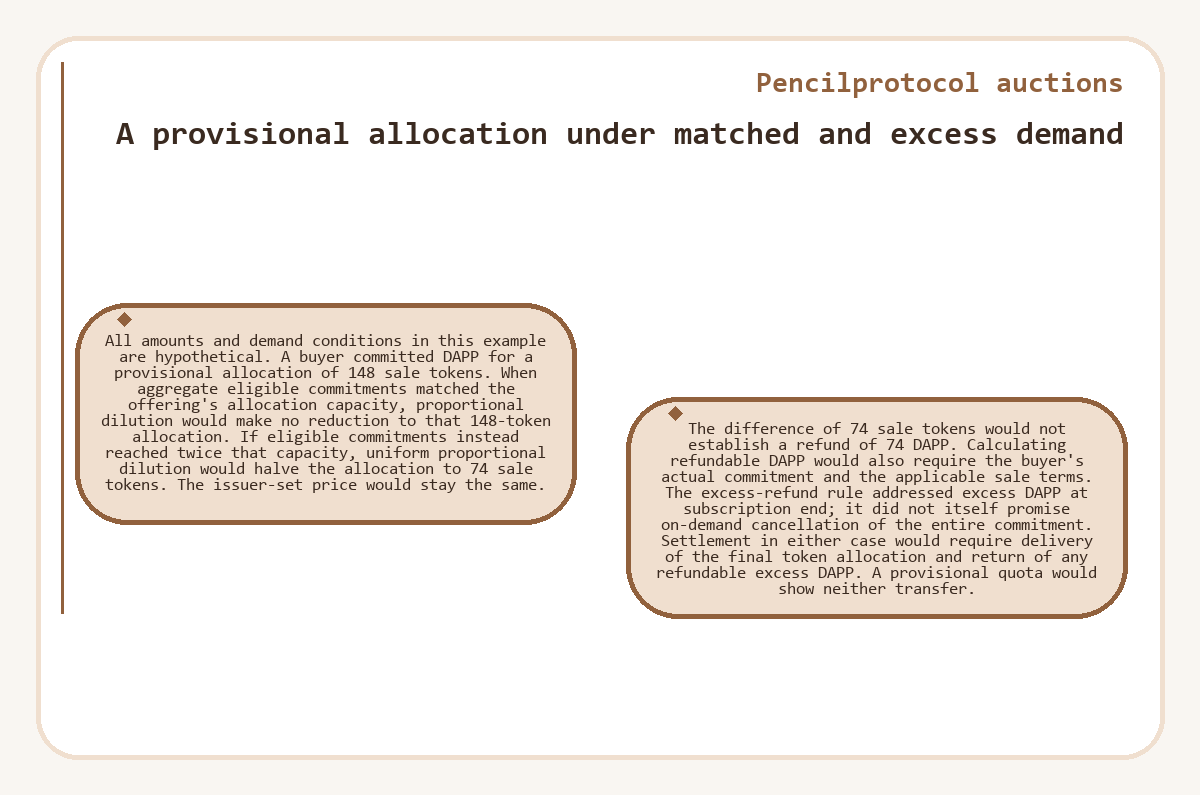
A provisional allocation under matched and excess demand
All amounts and demand conditions in this example are hypothetical. A buyer committed DAPP for a provisional allocation of 148 sale tokens.
When aggregate eligible commitments matched the offering's allocation capacity, proportional dilution would make no reduction to that 148-token allocation. If eligible commitments instead reached twice that capacity, uniform proportional dilution would halve the allocation to 74 sale tokens. The issuer-set price would stay the same.
The difference of 74 sale tokens would not establish a refund of 74 DAPP. Calculating refundable DAPP would also require the buyer's actual commitment and the applicable sale terms. The excess-refund rule addressed excess DAPP at subscription end; it did not itself promise on-demand cancellation of the entire commitment.
Settlement in either case would require delivery of the final token allocation and return of any refundable excess DAPP. A provisional quota would show neither transfer.
Seller collateral served a different purpose
Sellers also had a DAPP staking obligation, which the economy design tied to listing assets on the auction platform. Their stake served as collateral against misconduct, with the community overseeing the auction process. If misconduct occurred, the rules assigned that staked DAPP to redistribution among community members. This seller-side condition differed from the buyer's DAPP commitment, which determined participation and allocation under the subscription rules.
Community redistribution did not mean that every unsuccessful buyer automatically received the seller's collateral. The buyer's excess-DAPP refund and the seller's misconduct stake had different triggers and recipients.
Token sales formed part of a wider asset-auction remit
The fixed-price format covered SCR20 tokens and other digital assets within Pencils Protocol's Scroll-era auction offering. Its wider auction remit also included blockchain-native assets and real-world assets, or RWAs. These scopes differed: the concrete DAPP subscription provisions described token sales, while the broader RWA category came without asset-specific auction terms in the platform overview. Neither a token allocation nor a fixed price, by itself, described the rights attached to a particular real-world asset.
Pencils points added separate launch benefits
The points program described favorable future token allocations and discounted quotas for projects launching through Pencils Protocol. Pencils points and DAPP were different components of that design. The points benefits concerned launch access and allocation terms, while the fixed-price participation rules specifically named a DAPP commitment. Any discount's size and effect on a particular offering depended on that launch's terms.
Farming offered a historical way to earn Pencils points. A farming deposit, a points balance and an auction commitment nevertheless represented different activities within the platform.
When did the project announce its Dapylon transition?
Pencils Protocol announced its brand upgrade to Dapylon on May 15, 2025, with a May 31 retail withdrawal deadline. The notice requested withdrawals from the earlier platform. It also said funds remaining after that deadline would automatically return to the original wallet address associated with the user's account.
The project later announced that active yields and Scroll Marks had stopped, followed by a completion announcement covering user withdrawals and returns. It reported that all user assets had been withdrawn or returned to their originating wallets. This was a project-reported completion of the withdrawal process, rather than an auction-specific delivery record.
Any later offering under successor branding would need terms that applied to that sale. The historical pricing and DAPP quota rules alone did not establish a new subscription or token-delivery promise.
Pencilprotocol auctions: quick answers
-
Could buyers substitute pDAPP for the DAPP required by an auction?
- The historical auction participation rules named DAPP as the required staking token. A separate token-farming plan described pDAPP as a certificate issued at a 1:1 ratio for staked DAPP. That certificate ratio did not establish auction eligibility, a sale-token exchange rate or permission to substitute pDAPP for the specified auction commitment.
-
Were Pencils points transferable between people seeking launch allocations?
- Pencils were non-transferable community points in the historical program, so holders could not transfer a balance to another person seeking launch benefits. The auction participation requirement concerned DAPP staking, which was separate from the points program.
-
Did the absence of a price-guarantee deposit remove the seller's DAPP staking obligation?
- The auction highlights advertised no service fee or price-guarantee deposit for project launches, while the economy design separately required sellers to stake DAPP as auction collateral. These statements concerned different requirements. The absence of the advertised deposit did not erase the seller collateral rule or turn a buyer's participation stake into a launch charge.
-
Were promotional support and exchange listings automatic results of an auction?
- The historical auction offering advertised promotional resources and fast-track listing support for high-quality projects through ecosystem partners, designated exchanges and wallets. That was assistance with launching an asset. The support offer did not promise an automatic listing or a shared listing timetable for every auctioned asset.
-
Did May 31, 2025 set every auction's subscription deadline?
- May 31, 2025 was the retail withdrawal deadline in the May 15 brand-upgrade announcement. It did not define a common auction subscription window. The historical auction rules tied token distribution and refunds of excess DAPP to the relevant subscription period, which was a different condition from the platform's transition deadline.