 Pencilprotocol
 linked Pencils points to DAPP participation rights
Updated:Pencilprotocol linked non-transferable Pencils points to participation rights associated with DAPP, its system token. Early contributors could receive access to new farming methods and exclusive program terms. Points were also intended to inform future token allocations, subject to the relevant program. The mapping did not specify a fixed points-to-DAPP exchange rate or dividend entitlement. These relationships belonged to its historical Scroll-era design; the project later reported the end of active yields and completion of withdrawals during its Dapylon transition.
Rights mapping connected early participation with access
Points represented contributions
The economy design linked early adopters' Pencils balances with access to new farming methods and exclusive policies. The amount assigned through a token distribution involved a separate allocation rule. A balance linked to access therefore had a different meaning from a quantity of DAPP already assigned to its holder.
DAPP carried the governance role
DAPP had separate responsibilities as the system token, including governance and auction collateral. Token holders were the participants named for community voting. Pencils recognized contributions, whereas DAPP carried the governance function. The economy design connected these components through rights mapping without assigning every token-holder right to every points balance.
Allocation benefits depended on the relevant launch
Future allocations and discounted quotas
Pencils were intended to help calculate future token allocations as the protocol approached launch. Projects launching through the platform could also offer favorable allocations or discounted quotas, so the benefit depended on which distribution a participant considered and the participation terms that applied to that particular launch. An allocation of a launch project's tokens concerned a different asset from an allocation of DAPP. The points balance could affect either benefit without making the tokens, allocation quantities or launch terms interchangeable.
Airdrop priority and auction commitments
Priority placement in protocol airdrops was another stated points benefit. Priority described treatment within a distribution, without specifying an allocation amount. The auction design separately required participants to stake DAPP for quota. That token commitment concerned participation in a sale; points-related privileges did not replace the documented staking requirement.
Vault privileges concerned leverage and strategy access
Pencils and higher leverage
The points program included access to higher-leverage vault positions among its benefits. That privilege concerned the permitted position, while the vault mechanism supplied borrowed assets from the staking deposit pool. Points themselves did not provide the borrowed funds. Higher leverage increased the position's use of borrowed assets. Access to that position did not specify its return or establish a payment for the points holder.
DAPP staking and limited strategies
The economy design associated DAPP staking in Vaults with accumulating protocol and partner points, linking that activity to higher leverage multiples and priority access to limited strategy products. DAPP staking was the stated entry condition for this vault-specific route. The general points benefits did not define a uniform leverage multiple or strategy entitlement across all vaults. Access remained tied to the participation terms of the particular product.
The pDAPP ratio measured DAPP staking certificates
A separate token-farming design proposed issuing pDAPP when holders staked DAPP after the token generation event. The proposed staking mechanism specified one pDAPP certificate token for each DAPP staked. Pencils points were a different unit. The numerical ratio therefore described that staking relationship, without pricing an accumulated points balance.
A hypothetical stake explained the ratio
A hypothetical holder wanted to know whether the 1:1 ratio also valued Pencils. With an assumed stake of 137.5 DAPP under the proposed mechanism, the calculation was 137.5 DAPP × 1 pDAPP per DAPP = 137.5 pDAPP. A Pencils balance was not an input to that relationship and could not be valued with it.
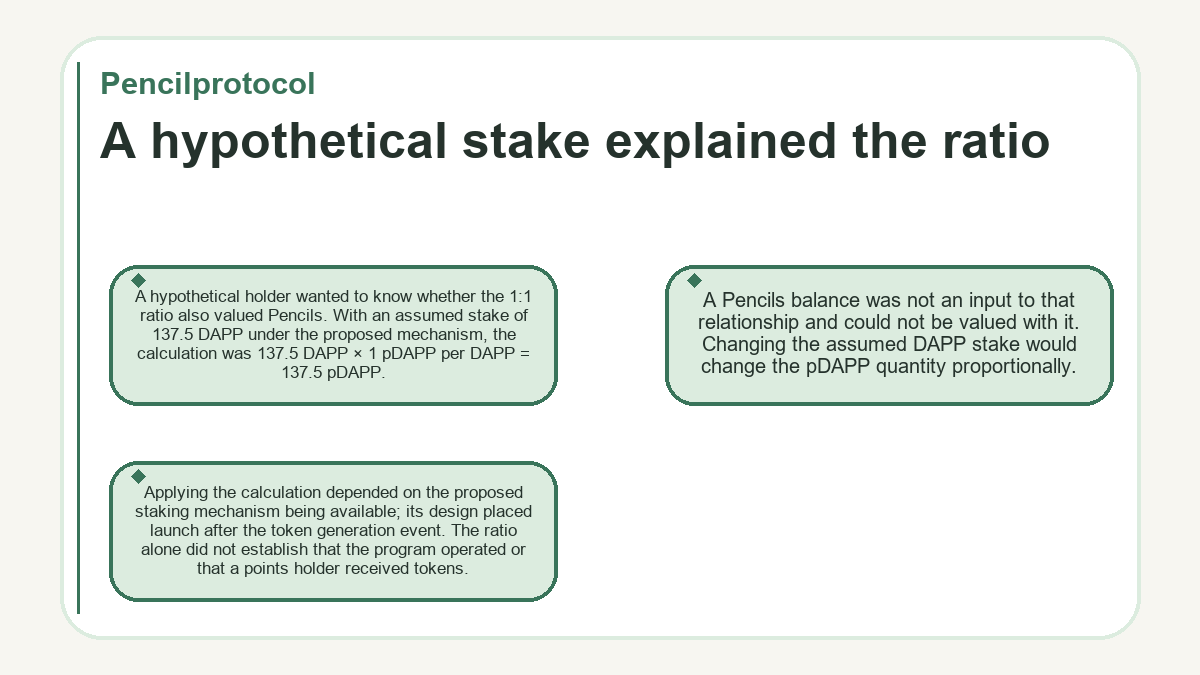
Changing the assumed DAPP stake would change the pDAPP quantity proportionally. Applying the calculation depended on the proposed staking mechanism being available; its design placed launch after the token generation event. The ratio alone did not establish that the program operated or that a points holder received tokens.
Pencils remained non-transferable participation points
The Pencils points program specified that its points were non-transferable. This limited the meaning of a displayed points balance: it recorded participation within the program, without defining a transferable token holding. A balance could inform allocation or access terms without functioning as a quoted sale amount. The economy design gave DAPP no dividend entitlement. Neither a points balance nor its connection with DAPP established a claim to distributed protocol profits.
The 2025 transition changed the operating context
On May 15, 2025, the project announced its Dapylon transition and asked retail users to withdraw funds by May 31, 2025, with any remaining assets scheduled for automatic return to the original wallet address associated with their account. The withdrawal notice concerned assets held on the platform. Its deadline did not describe a points conversion window.
The project subsequently reported that active yield generation and Scroll Marks had stopped. It later announced that all user assets had been withdrawn or returned to their originating wallets.
That completion statement reported the project's withdrawal process; it did not establish an individual wallet's transaction history or a settlement formula for points.
Any later entitlement attached to an old Pencils balance would depend on terms that explicitly covered that balance and benefit.
Common questions about Pencilprotocol
Could people earn Pencils without staking supported assets?
The historical points program included marketing participation as an earning route. It covered promotional campaigns and contributions as an influencer, ambassador, volunteer or partner. These activities provided another way to accumulate points alongside staking supported assets.
Which decisions did DAPP governance cover?
DAPP governance covered community voting on development direction, interest rate matters, protocol policies and emergency measures. The points mapping concerned participation-linked access and privileges; it did not state that a Pencils balance automatically carried the full voting rights associated with holding DAPP.
Were Pencils intended to pay for items in the planned Shop?
The points program described using Pencils to purchase items through the planned Shop. Its stated categories included NFTs and virtual or physical goods, alongside merchandise. This was a proposed use for participation points. It did not establish a universal points price for an item or show that a particular product was available for redemption.
Did Scroll Marks and Pencils represent the same reward?
Scroll Marks and Pencils were separate rewards within the historical farming design. Pencils belonged to the protocol's participation program, while Scroll supplied its own ecosystem incentives. The project announced that it would not participate in Scroll Session 2 and later reported that earning Scroll Marks had stopped. That change did not establish a conversion between Marks, Pencils and DAPP.
Why did points accrual use the USDC-equivalent value of staked assets?
USDC-equivalent value expressed the amount of eligible assets used to calculate staking-based Pencils output. It did not price an individual Pencil in USDC or establish a DAPP exchange rate. Asset value and the applicable earning schedule concerned how points accumulated. Allocation terms concerned what those accumulated points could enable, which was a separate relationship.