 Pencilprotocol
 farming - deposits that funded vault borrowing
Updated:Pencilprotocol farming supplied pooled assets that vault users borrowed to expand liquidity positions on Scroll. Depositors earned floating interest from borrowers, while Pencils points and Scroll incentives followed separate reward rules. This was the funding side of Pencils Protocol's yield model, distinct from the leveraged position that used the capital. During the 2025 transition to Dapylon, the project announced the end of active yields and later reported completed withdrawals or returns.
Borrowers paid the pool that rewarded depositors
A farming depositor supplied capital to a shared pool, and a vault participant borrowed capital to enlarge a strategy position. The system used staking terminology for funding-pool deposits as well as for staking liquidity provider (LP) tokens within a strategy. Those actions had different purposes: one supplied loan capital, while the other sought returns from a liquidity position.
An LP token represented a contribution to a decentralized exchange (DEX) liquidity pool. LP staking rewards and deposit interest could therefore appear within the same system as different income streams. The depositor supplied the funding pool; the vault participant selected a liquidity strategy and leverage multiple.
Pool utilization changed the historical APR
Utilization measured the share of supplied funds that borrowers had drawn from the deposit pool. In the historical farming model, higher utilization increased the depositor APR. The model lowered the rate when borrowing used a smaller share of the pool.
APR meant annual percentage rate and expressed interest on an annualized basis. A displayed rate reflected the pool's borrowing conditions at that point. Changes in borrowed funds or available supply could move utilization and change the rate. A larger supply alone did not establish stronger returns; the borrowed share also mattered. The model described a floating relationship, without setting a permanent percentage for every supported asset.
Farming assets and incentive balances served different purposes
The initial farming plan covered ETH and related assets, WBTC, stablecoins and the protocol's DAPP token. It also listed a Scroll-token category with a launch condition. ETH-related assets included wrapped ETH, liquid staking assets and liquid restaking tokens (LRTs).
The principal remained an asset balance; Pencils recorded participation under a non-transferable points program.
The farming design layered Pencils and Scroll incentives alongside borrower-funded interest. The asset-specific Pencils schedule expressed accrual relative to the USDC-equivalent value supplied and a time interval. Asset groups carried different points multipliers. Those multipliers governed points accrual, while utilization governed the floating deposit interest rate.
Points-related benefits included preferences in project-launch allocations and access to higher vault leverage. The relevant launch or strategy terms controlled these privileges, separately from the loan interest that the funding pool earned.
Vaults 1.0 described borrowing for LP positions
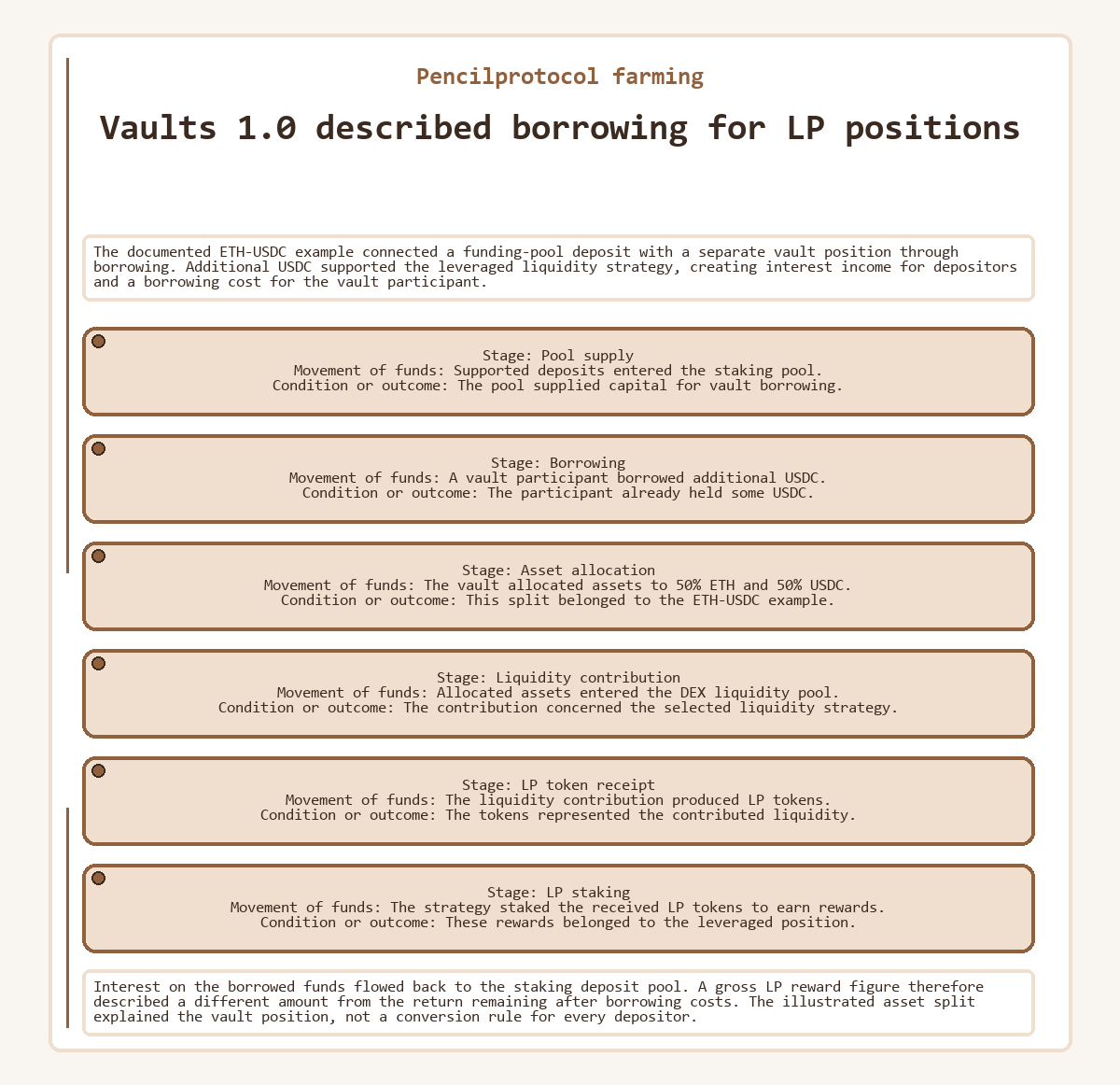
The documented ETH-USDC example connected a funding-pool deposit with a separate vault position through borrowing. Additional USDC supported the leveraged liquidity strategy, creating interest income for depositors and a borrowing cost for the vault participant.
| Stage | Movement of funds | Condition or outcome |
|---|---|---|
| Pool supply | Supported deposits entered the staking pool. | The pool supplied capital for vault borrowing. |
| Borrowing | A vault participant borrowed additional USDC. | The participant already held some USDC. |
| Asset allocation | The vault allocated assets to 50% ETH and 50% USDC. | This split belonged to the ETH-USDC example. |
| Liquidity contribution | Allocated assets entered the DEX liquidity pool. | The contribution concerned the selected liquidity strategy. |
| LP token receipt | The liquidity contribution produced LP tokens. | The tokens represented the contributed liquidity. |
| LP staking | The strategy staked the received LP tokens to earn rewards. | These rewards belonged to the leveraged position. |
Interest on the borrowed funds flowed back to the staking deposit pool. A gross LP reward figure therefore described a different amount from the return remaining after borrowing costs. The illustrated asset split explained the vault position, not a conversion rule for every depositor.
Vaults 2.0 described a different yield mix
Vaults 2.0 proposed liquid-restaking integration, with native restaking yield and token incentives attached to that strategy. The Vaults 1.0 design centered on leveraged DEX liquidity positions. Farming's funding-pool interest referred to payments from borrowers, separately from the rewards that a strategy could receive.
Delta-neutral strategies, synthetic yield and exotic options belonged to longer-range vault plans.
Borrower checks and leverage caps targeted depositor protection
The design assessed borrowers' principal and limited leverage multiples to protect capital in the staking deposit pool.
The historical Pencils Protocol Vaults description presented those controls as protection from liquidation risk for depositors. That protection claim concerned the funding side of the arrangement. It did not establish the same protection for a leveraged LP position.
The 2025 transition stopped active farming yields
Active yield on deposited funds ended during the transition. The platform's end-of-yield notice also said that Scroll Marks accrual had stopped. Older descriptions of interest and incentive layers therefore described the former Scroll farming model, rather than an ongoing earning offer.
Pencils Protocol's May 15, 2025 brand-upgrade announcement set May 31, 2025 as the withdrawal deadline for retail users. The announcement named Dapylon as the successor. Subsequent notices described automatic returns; the project later announced that all user assets had been withdrawn or returned.
The successor announcement described Dapylon's planned cross-chain yield aggregation. It directed retail users to withdraw their Pencils Protocol funds, keeping those plans separate from continued earnings on old Scroll deposits.
Key questions about Pencilprotocol farming
Did claiming farming income also withdraw the original deposit?
The historical interface used different controls for claiming income and withdrawing principal. Its instructions placed income claims in the Supply & Borrow info section, while principal withdrawal used Withdraw within Manage. These controls belonged to the earlier farming interface, before the project reported completed withdrawals.
Which form of Bitcoin did the initial farming plan describe?
The initial plan named WBTC in a category for EVM-compatible BTC collateral tokens. It described a token deposit, with the supplied collateral providing capital for borrowers.
Did the Scroll Session 2 decision end every farming reward at once?
The Session 2 decision specifically addressed Scroll Marks, rather than every source of farming income. The farming-adjustment announcement said that deposited assets would no longer earn those session rewards because the project would not participate. A later platform notice addressed the end of active yield more broadly. The earlier Marks decision alone therefore did not establish when borrower-funded interest stopped.
Where were unwithdrawn farming assets supposed to return?
The transition plan directed automatic returns to the originating wallet associated with the Pencils Protocol account. Manual withdrawal let the user choose a preferred wallet. The May 15, 2025 announcement attached those arrangements to the May 31, 2025 withdrawal deadline.
Does the completed-withdrawals notice confirm an individual farming wallet's receipt?
The completion notice reported a project-wide outcome, without independently confirming a particular wallet's receipt. The team stated that all user assets had been withdrawn or returned to originating wallets. A wallet-specific receipt would require its own transfer record.